
Chainmaille for Autumn Gatherings

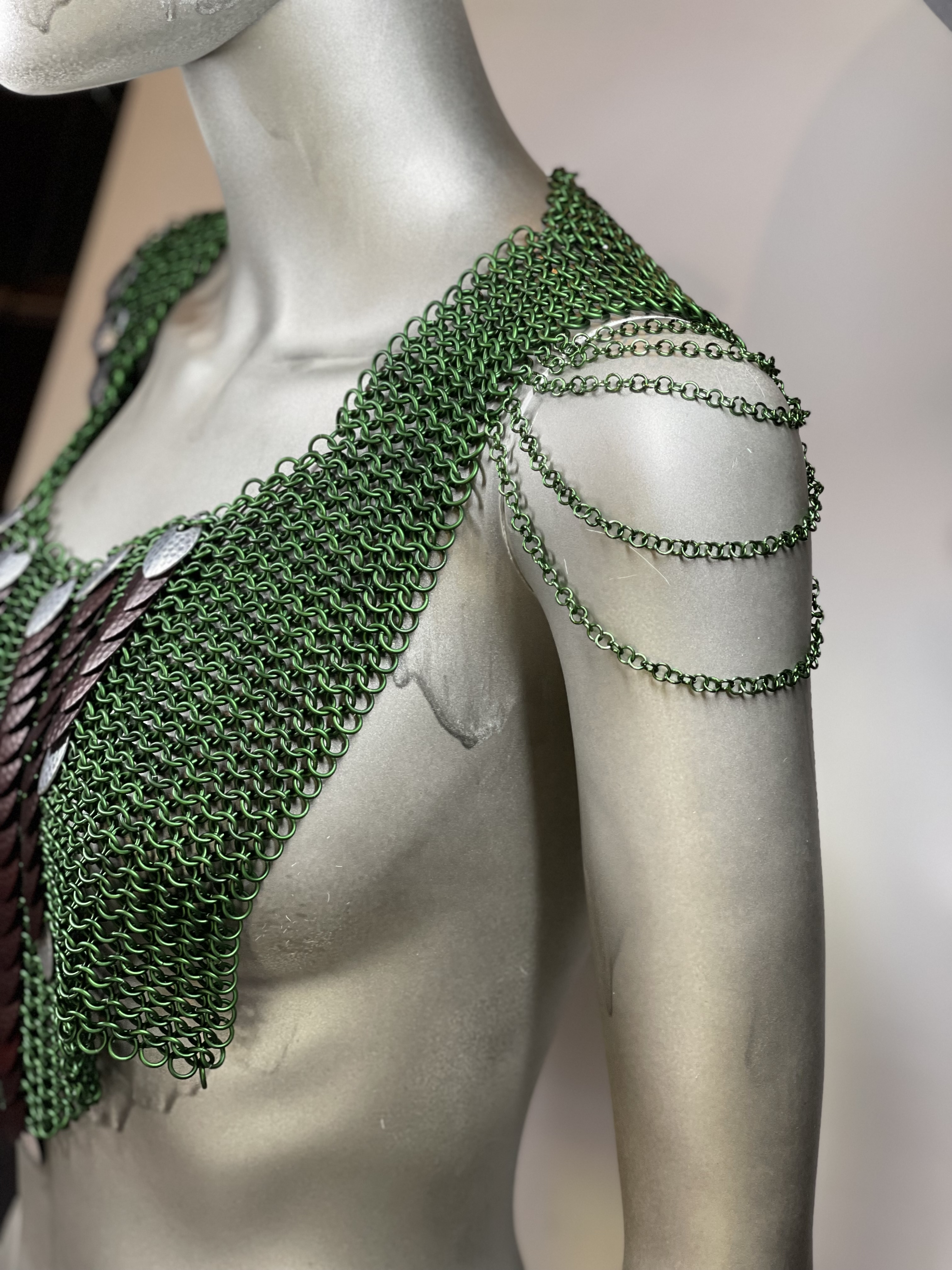
Chainmaille isn’t just for solitary warriors or distant realms. Sometimes, it belongs in the laughter between friends, the clink of wine glasses, and the golden hush of fall. For the last of our Early Autumn looks, we styled our newest piece – Midgard –  in bronze, tan, and grey—for a sunny outdoor gathering. The result? A look that blends warmth, strength, and celebration.

The Weave That Speaks

European 4-in-1 is one of the oldest chainmaille patterns, but here it’s reimagined in soft autumn tones. Bronze scales add depth and movement, catching the light like falling leaves.

Styling for Connection

We paired the piece with a light fall jacket and black jeans—simple, modern, and perfect for layering. The chainmaille becomes a centerpiece, not a costume. It says: I’m here, I’m strong, and I’m part of this moment.

Armor in Celebration

There’s something powerful about wearing armor in joy. Not as defense, but as decoration. As identity. As a way to honor the stories we carry, even as we make new ones.

Want to see more seasonal styling?

Visit the Modern Wear gallery

Styling Chainmaille with Soft Power

Chainmaille doesn’t always need a battlefield. Sometimes, it belongs in the hush between sips of coffee, layered over denim and worn like a whisper of strength. This week, we styled our purple-and-lavender panel for a café setting—sunlight in auburn waves, silver chains catching the breeze, and armor worn with ease.

Color as Mood

Purple evokes mystery, intuition, and quiet confidence. The lavender and silver scales add softness, like moonlight on metal. Together, they create a palette that feels both regal and approachable.

Layered for Balance

A black blazer adds structure and contrast, while the chainmaille remains the focal point. The scoop-neck tee underneath keeps things casual, letting the metalwork shine.

Soft Power in Everyday Rituals

There’s something powerful about wearing armor in a gentle moment. It’s not about defense—it’s about presence. About showing up in your own story, fully adorned. 

To see more modern looks, check out our Modern Wear gallery.

Styling Chainmaille for Everyday Ease

Style blue-and-grey chainmaille for modern life—layered with a black jacket and worn at a café. Discover how to wear armor with ease and elegance.

Chainmaille doesn’t always need a forest backdrop or a Viking hall. Sometimes, it belongs in the hum of the every day, layered over denim and paired with a quiet moment. This week, we’ve styled our blue-and-grey chainmaille Winterborne for a modern setting—coffee in hand, jacket unzipped, and sunlight catching the shimmer of silver scales.

Cool Tones, Warm Confidence

The sky-blue and grey palette feels fresh, like morning light on water. It’s a softer kind of armor—one that invites rather than intimidates.

Layered with Intention

A black jacket adds contrast and structure, while the chainmaille remains the centerpiece. The vertical row of alternating scales draws the eye and elongates the silhouette.

Everyday Rituals, Extraordinary Style

There’s something powerful about wearing chainmaille in a quiet moment. It’s a reminder that strength can be subtle—and that beauty doesn’t need a stage.

Want to see more seasonal styling?

Visit the Modern Wear gallery

Styling Chainmaille for Everyday Confidence

Chainmaille doesn’t have to wait for a battlefield or a festival. Sometimes, it belongs at a café, paired with denim and a quiet smile. This week, we’ve styled a bronze-scaled chest piece—usually reserved for mythic realms—for a modern moment: coffee in hand, sunlight in auburn hair, and armor worn with intention.

The Power of Bronze

Bronze is warmth. It’s the color of autumn leaves, ancient coins, and quiet resilience. For this piece, we have layered bronze rings and golden scales to create a look that feels both protective and poetic.

Modern Pairings

Styled over a soft blouse and under a light jacket—just enough structure to let the chainmaille shine, but casual enough for a café setting. Blue jeans ground the look, making it wearable without losing its edge.

Confidence in the Everyday

There’s something transformative about wearing armor in a mundane moment. It reminds us that strength isn’t always loud. Sometimes, it’s sipping coffee while the world rushes by, knowing you’ve woven your own story.

Want to see more seasonal styling?

Visit the Modern Wear gallery

Styling Chainmaille for Modern Life

Chainmaille isn’t just for battlefields or fantasy realms. In our studio, it’s woven with intention—for everyday wear, quiet strength, and unexpected elegance. This week, we’ve styled one of our favorite pieces for a casual café setting. The result? A look that turns heads without shouting, blending mythic texture with modern ease.

Layered for Comfort and Contrast, we pair the chainmaille panel with a sage green blouse and a light fall jacket. The soft drape of the fabric offsets the metallic weave, creating a balance between armor and airiness. It’s a reminder that strength doesn’t have to be rigid—it can be graceful, too.

Denim Grounds the Look.  

Blue jeans add a familiar, wearable base. They anchor the outfit in the everyday, making the chainmaille feel like a natural extension of personal style rather than a costume. Whether you’re grabbing coffee or heading to a gallery opening, this pairing works.

Details That Whisper, Not Shout  

Olive fringe and dark bronze scales add depth without overwhelming.  Keep accessories minimal—just a few rings and a soft wave in my hair. The chainmaille speaks for itself.

Make a Statement without saying a word. This piece catches sunlight and city reflections. It’s a quiet rebellion against fast fashion—a handcrafted statement in a world of mass production.

Does this mean we’re Fancy?

Article #10 in our Craft Show Advice: What to look for when looking for a Gallery.

So you’re doing it. You navigated the weirdness and learned what it takes to be a successful Art or Craft Show Vendor, peddling your Handmade Goods to the masses.

Cool!

But as you spend time between Shows, putting your product images and details online in your free web page because you learned – either ahead of time or the hard way – that Etsy and other pay-to-play sites are a waste of your time and profits, you start to wonder what it might be like to see YOUR Handmade products on display in an actual brick-and-mortar.

You remember those, don’t you? Although in this some-day post-Covid world, maybe those have gone the way of the DoDo. Well if they have, then this entire article could be moot, but go ahead, amuse yourself by reading it anyway.

Having “Been there, Done That and learned a lot” we have a few pointers for you to keep in mind when exploring this idea.

Those of us who live the gypsy life of the Art Show Vendor often pride ourselves in NOT being for sale in a brick and mortar. What we’re really saying is we’re glad to be mobile and free and not the OWNER of a brick and mortar. Truth be told, if someone else has a few bricks and a nice little shop, we would jump at the chance to slap our products on those shelves and split a few bucks with you.

Seriously. The Velvet Zebra is always looking for a new little quirky shop or shop owner to take a fancy and want our products on their shelves. For a few years, as we were realizing the popularity of our Chainmaille jewelry and designs, we would spend our Vendor Down Time contemplating the idea. We read articles, did research, but damn it wasn’t nearly as simple as those magazine stories kept suggesting.

“Create an elevator pitch” they said. “Bring samples” they said. “Find shops that seem likely to carry what you sell” they said “Be persistent,” they said. “Follow up with managers,” they said.

What we heard was “Annoy strangers to the point of them not wanting to see you in their store ever again.”

Seriously, unless Sales is your life-long passion, it’s not a simple thing to walk into a cute little niche store that you admire or enjoy, then basically pester the manager about carrying your products when they likely don’t even have the power to say Yes anyway because little did you know, they’re owned by a larger group that has no intention of talking to you.

If you love that, super. Do it, then tell them you know of a great Chainmaille company that is also available!

If you hate that as much as we do, it’s gonna be harder. And being hard doesn’t mean you don’t believe in your product or that you lack the conviction required to back your own workmanship and produce a viable Handmade product. It just means you’re not good at that kind of confrontation. And don’t kid yourself, selling YOU to a stranger who hasn’t asked for your pitch or your notions of greatness is a form of confrontation.

Galleries are another story – easier to get in based on the fact that the nature of most galleries is to carry Art from locals – but it’s still not a sure thing. They have to have openings, your prodct has to be a good fit, and there are rules and such you may or may not be on board with.

First we’ll confess that for us, our introduction into Galleries was a fluke, and likely not to happen again as luck would have it.

One day, after a few years of wondering, researching, reading and deciding that trying to blindly sell ourselves to shop owners wasn’t in the cards, as we were sitting in our booth at our favorite yearly summer Art Show, it happened. Now, keep in mind it didn’t happen to just US, they were visiting the Art Show on purpose, selecting such Art as they deemed appropriate.

The manager of a gallery right there in town came to us with an offer, and a contract, to join their gallery. They’d had a Chainmaille artist for a few years, but his products were too expensive and therefore not bringing in any sales. He wanted out, and they wanted us.

Being wholly unfamiliar with Gallery-joining, we showed that contract to a fellow vendor at the show, one we trusted and knew were also in galleries. When they examined the terms and assured us it was a stellar contract, one they would have signed immediately had they been offered, we decided it might be worthwhile. The day after the show closed, we took samples and had a discussion with the gallery owners, and by that next weekend made our first delivery.

Thus began a 3-1/2 year adventure full of ups, downs, and frankly quite a lot of sales. Unfortunately, the Gallery owners were bat-shit crazy and eventually divorced and lost the business. Until that point, we enjoyed rather impressive sales but were frustrated by the lack of diversity.

We don’t mean cultural diversity. The woman in charge of picking products only liked “Earth Tones” of her choosing. She wanted only certain shades of Blue, Green, Brown, Red, Black and Silver. Anyone familiar with our work knows we enjoy COLOR. And our clients enjoy our use of color as well. But for this gallery, we could only work in those tones. We believe, had she allowed the inclusion of ALL of our color choices, we would have sold even more.

While our product was in this Gallery, the owner of another Gallery contacted us about also displaying in her shop, in Colorado. We made a large wholesale to her up front, but after a year it became too difficult to manage an out-of-state relationship and we pulled out.

At the time of the divorce and the Gallery closing, we were happy to leave. The relationship was changing, the terms were changing, and we were pretty angry. But now we’re feeling the emptiness and wishing we could get back into a Gallery or Shop.

So now you’re wondering why we’re telling you this, and not giving you the promised advice. Never fear!

Whether a Shop or a Gallery, if you’re putting your Handmade goods into someone else’s business, there are going to be terms to deal with. Terms that can benefit you, them, or both, but only if you’re careful.

Clearly the Gallery or Shop needs to make money carrying your Products, that’s a given and easily understood. Even more clearly, YOU need to make money, as the Artist supplying the Products. Neither of you wants to get screwed over, so you’ll want clear expectations regarding your profits, terms and expectations.

The Terms we agreed to were a 60/40 split, with no exit penalty and a 30-day notice of cancellation.

What that meant was for every dollar made, we kept .60 cents, they took .40 cents and if we ever walked into the Gallery and said we wanted out, they would give us all remaining unsold pieces and we could just leave. And if they didn’t want us any longer, they had to let us know 30 days in advance of us picking up our unsold pieces.

At 60/40 we were able to still make a profit after subtracting our cost of materials and the Gallery’s 40%. We had to adjust our picing slightly but at the time we had been undercutting ourselves a bit, and our Gallery sales were proof that our pricing was in line with the norms and our clients acceptability.

Clearly the Gallery deserved earning 40% of our sales because they were running the Gallery, they were paying the rent, they were processing the sales, and they were managing the taxes. When the second Gallery came along, since they were in Colorado and we aren’t, we made a large Wholesale deal with them, then using the same terms, arranged to give them inventory when needed to take to Colorado. Unfortunately being so far away it became too difficult to manage and we cancelled that arraignment a year later.

When the divorce came to a head, and the Gallery we were in began having issues, the owner decided it was time to alter the Terms. He wanted to do a 50/50 spit. It was that point we packed up and left. Three months later, they were closed, divorced and history.

So now you’re thinking “But, I mean, 50/50, that can’t be so bad, right?”

Wrong.

Remember you’re the Artist. YOU have to buy the supplies that go in to the making of your Product, and spend your time making the Product. So at 50/50, you will NEVER make more money than the Gallery. If you don’t make more than the Gallery, you’re just an employee working for THEM.

If you spend $20 to make, say, a felted hat. Never mind the time and effort and artistry it takes, you are immediately in the red for $20. You take that felted hat and give it to a Gallery, priced to sell at say $100 just to make it simple. Now it sells and the Gallery keeps it’s 50%, which for this felted had equals $50 bucks, and they give you your 50%, which is also $50 bucks.

But YOU started out $20 in the hole, remember, because YOU were the one who paid for the yarn that you made the felted hat with. So your profit is only $30.00. It’s easy to forget that before you can count any profit you have to take into account all debt..

For a second you think “Oh, just add another $20 and sell the hat for $120” Doesn’t matter. You still get 50% of $120 and have to subtract that $20 you spent. So at 50/50 split, you will never make more than the Gallery, and you won’t even make the same amount, because you will always be the one buying supplies and starting in the hole before any sale.

The gallery we were in was just your standard, average Gallery, owned by a person (or couple) who filled it with Art from local Artists that they found appealing. There is another type of Gallery out there – known as a Co-Op – that you’ll find a little easier to get in with, but the Terms are vastly different and might not appeal to you, the same way they do not appeal to us.

Being a Co-OP Gallery means it is operated by the very Artists whose work is displayed inside. In order to operate, they rely on the Artist participation and membership. This does not in any way reduce the quality of the Gallery or the Art found inside. But it does add a layer to the usual Terms.

If you want your Art in a Co-OP Gallery, you’ll have to be willing to commit 2-3 days a week, or some number of hours per week or per month, working IN that Gallery. Also you’ll likely be expected to purchase a membership that will renew yearly, which can be anywhere between $60 and $800. So on top of giving the Gallery a good percentage of your profits after every sale, you’ll be working as a sales cleark several hours a week (you don’t get paid for that, remember) and before you make a single sale of your own Art, you’ll be out not just your supplies and time, but also that $60 to maybe $800. Some of them even charge a “rental” of whatever shelf or floor space your Art will occupy.

It’s the in-store version of an online sink-hole, wherein your are out a LOT of money up front, and have to give up a LOT of your own time, before you’ve made a single sale. That Gallery might be fantastic and you might sell tons, but keep in mind you aren’t profitable until you’ve paid the debts incurred first.

The Velvet Zebra have day jobs. Essential-Worker day jobs that pay quite well, provide retirement and health insurance, and cannot be tossed aside so that we could work for free in a gallery 3 days a week to sell Art made my ourselves and others. And reading these Articles, you already know how we feel about paying out sums of money prior to making any sales.

HOWEVER – if this idea appeals to you, and you’re okay with Terms like that – then by all means go ahead. You might find working there very fullfilling, even though- again – you don’t get paid to work there. You working there is part of your agreed upon Terms, and being a Co-Op Gallery that’s how they keep the lights on. Just remember, having your Art in a Co-Op Gallery is NO LESS amazing, fun and Fancy-As-All-Hell than being in any other Gallery.

It’s just different. With different Terms.

We’re always on the lookout for another Gallery. Maybe someday we’ll find one with Terms we can agree with and the same success we enjoyed before. Maybe someday a small Shop owner will approach us about putting our products on their shelves.

It nearly happened one day, as we were shopping around one of our favorite little towns. Simply by wearing our product, we caught the eye of the shop owner’s wife who asked for our card and website to show her husband. We were intrigued, and a little hopeful, but that husband never contacted us. Just as well, as a few years later he went under.

In the meantime, Covid-be-damned, we’ll do our Summer Art Show, and hopefully one we wanted to try before Covid closed them all. We’ll continued to sell on our own Webpage (right here where you’re reading this) and we’ll continued to Chain-on until our fingers fall off !

And while you’re waiting to see if all the good Art and Craft Shows will come back this year, you can hang around here for more good Tips and Tricks to get your booth and your gypsy lifestyle started out right!

Check out our next Article: Displays and Set-Ups, the DIY-Of-It-All !

Seriously, can NOTHING be Simple?

You’re an Artist. You make something wonderful, by your own hand, and you want to start selling it. Good for you!

But you have questions – like:

How much should I charge?

Do I need my own webpage?

Should I sign up with Etsy?

Are Facebook / Instagram Ads really the way to spend my money?

Is this How-To article on going Viral a good use of my time?

Well buckle up, Betty, you’re about to read a very frank, no-holds-barred article full of opinions, experience, advice and balls-out facts. You’re going to have to decide for yourself if we’re off our rockers or maybe speaking a grain of ugly truth. In fact, most of the advice you’ve probably read up until now suggests you should never disclose stuff like this, but we’re not average.

So if you want answers to those quesitons that speak more from truth than the standard confusing rhetoric you’ve been finding, we’ll happily show you the hairy underbelly of the Velvet Zebra.

Question #1 on most people’s minds when they’re considering selling their Handmade items is: How Much Should I Charge?

No doubt you’ve been looking around the web, you’ve even Googled that very phrase, thinking there’s probably some logical formula out there that everyone uses to calculate their costs to produce their perfect sell-for price only to find a convoluted, somewhat confusing explanation that looks something like this:

Cost per Unit x Hourly Wage + Utilities / Rent – Wholesale = Fukitol.

And it makes about as much sense as a Government Budget.

Look – unless you’re opeing a brick and mortar, or you really CAN calculate the number of kilowatt hours you used while making your single unit, how many ounces of water you may or may not have consumed during the making of that unit, figure in what you ate for lunch and come up with some kind of hourly wage you feel you should be making, there’s really an easier way to do this:

Cost x 3 = Retail. Cost x 2 = Wholesale.

The two of us who make up The Velvet Zebra have day jobs – thankfully they’re essential day jobs – if we factored in our hourly wage to our Chainmaille, we wouldn’t sell a single item because the prices would be absurd. And our studio is our home, so the lighting we ‘used while making it’ would have been used reading a book, taking a nap or petting a cat if we weren’t making a product, so let’s be serious.

If you knit, you know exactly how much yarn costs, and how much yarn you used to make that scarf. Take that cost, multiply it by 3 and you have your retail price. Now you’ve made back exactly what it took to make the scarf, so you can make another plus enough profit to either make 2 more identical scarves, or slap it into the bank.

Your wholesale price is lower, but remember wholesale means you’re selling in bulk – you’ll get a big hit of income straight up, and hopefully orders for more, so your profit is volume. For wholesale you’ll want to set a minimum order, for instance ours is $500.00. That’s up to you.

Question #2: Do I need my own Webpage? That depends on a few factors only you can decide, but keep in mind if you’re just now starting out, and you’re asking this question, do NOT spend any money on a webpage! It’s not like buying a new puppy and immediately you need food and water bowls, a leash, a bed, vaccines and something to clean that pee stain off your rug.

You’re just starting. You don’t know for a fact this stuff is going to sell, how well it’s going to sell, or that you’re going to keep at it. You don’t know Jack just yet.

You can get a WordPress blog for nothing, literally, and make it into just about anything you’d like. As you grow — if you grow — that WordPress blog can be altered and grown, in stages and for not a lot of money. If you’re reading this article you’re at a WordPress blog. It says TheVelvetZebra.com in your browser because we pay WordPress a yearly (nominal) fee for the domain name. As we grew, we also upgraded our site to one that allows a BUY button on our listed items. We did NOT upgrade to the plan that is straight-up eCommerce because that plan is pricey. I’m sure it’s worthwhile, but bear with us as we continue on, there’s still lots of information here you can use and not pay a single dime for.

There are loads of eCommerce sites you can pay to use. Sites like Big Commerce, Shopify, WooCommerce et al – where you can set up a web store relatively easily, but pay a monthly fee for the pleasure. We’re talking, on average, $30/month. That’s thirty dollars of YOUR profit, even before you’ve made a profit. Per Month. Including the months when you dont’ sell a single thing. We hate to say it, but you’re going to go several months, quite possibly even years, making zero dollars a month before it kicks into gear and turns a profit. That, or you’ll shoot out of the gate like wildfire thanks to friends and family, then grind to a smashing halt when they’ve had their fill. Now you’re in the hole, and don’t even kid yourself that you’re profitable until all of what you’ve spent has been made up, and then some.

If you’re already using Square to take payments – or you’re about to sign up (and you should if you’re not into PayPal) you need to know they will GIVE you a website of your very own. It’s a web page where you can showcase ALL of your products, loads of photos, videos, and full descriptions, product variations, simple set up using templates – all for free. They will process your purchases via whatever plastic cards your customers want to use, they’ll send the receipt, tell you who bought what and where to ship it, calculate in whatever shipping charges you want, taxes you’ve set, and any promotional sales or giveaways you desire. They even have code that will give you a “button” to put anywhere, at not cost to you, that turns every social media outlet, or blog, or Facebook post into your own personal eCommerce store.

For. Free.

The only thing you’re paying for is the processing fee that you pay any time your customers hand you a credit card at an Art Show – 2.3%. You’re gonna pay that anyway, whether your customers are in person or using your web page. The kicker is, when you’re not making sales, they’re not charging you anything.

Now ask yourself – does it matter WHERE your webpage is, if it’s your webpage, your brand, your products, and your customers will have no difficulty using it?

Now you have a FREE WordPress blog – if you spent a tiny yearly fee you have your own domain on that FREE WordPress blog – if you’re using Square (PayPal is doing it now too) you can put a Direct Purchase button on any product you showcase on that free page, turning your Free WordPress blog into a Free eCommerce site.

Nifty, huh? And it doesn’t matter “where” your page resides.

Keep in mind, no one is going to find your website unless YOU tell them where to look, regardless of who is hosting it. Shopify, Big Commerce, etc, aren’t spending two cents advertising for you. YOU are paying THEM, so they don’t need to tell the world you exist, that’s not their business model.

Their business model is selling web pages to YOU.

Keep that in mind as we continue . . .

Question #3: Should I sign up with Etsy? In a word – No. In two words – Hell No. If you want to, go ahead, we’re not going to stop you. Your friends probably have Etsy pages. People you meet on the street have Etsy pages. You’re seeing commercials and reading articles in magazines about house fraus making millions from their Etsy shops all the time.

You know why they write about the occasional House Frau? Because that’s so rare, it’s newsworthy.

Here’s the deal – Etsy’s expensive, especially for a Handmade Artist just starting out. They’ll charge you Per Item to list a product for a limited time, then take a cut for running your customer’s credit card, and if your item doesn’t sell within a set time period you have to take it down, or pay again to keep it listed. Here’s the other deal – your customers have to sign UP with Etsy just to shop! They can’t even BUY from you unless they, too, have an Etsy account. Now they’re gonna get spammed by Etsy whether they bought from you or not.

Now here’s the ugly truth – Etsy isn’t a group of Handmade Artists supporting each other, they are a corporation who’s product output is Data Mining. Etsy doesn’t care if you do well. They got their money when you signed up and started posting your products. They get even more when they data-mine from your customers, who had to sign up just to make a purchase. They get paid again in a month if you have to list that item again, or the item’s replacement if it sold. They’re getting paid just because you’re there – how much are you making? And they make damn sure you read about those House Frau’s because that will make you think you can do just as well, and you’ll stay. They know you read that article “How Jannette went from making nothing to 40k a month with her Etsy Soap Shop!” And they know you’re assuming that could be you one day.

Ponder this for five minutes, then make up your own mind:

Let’s say you make a teapot that you sell for $40.50. It costs you $13.50 to make the teapot and you price it at cost x 3 = $40.50, but to appeal to shoppers, you’re going to offer Free Shipping. Now you list it on Etsy.

It’s going to cost you .20 to list that single Teapot for 4 months. Only 1 Teapot (fees add up when you have more than 1 available item or version of that item) then when it sells, you pay Etsy a 5% transaction fee, (that’s 5% of the price you listed the teapot) then a payment processing fee of 2.9% + .30 per transaction.

Your Teapot’s costs are:

$13.50 to make

$15.00 shipping flat-rate medium box for your tiny teapot with lots of padding.

$2.03 = 5% transaction fee (this would be doubled if you hadn’t added “free shipping” because Etsy would charge you a shipping processing fee)

$1.47 = 3% payment processing fee +.25 charge

.20 = product listing fee

.20 = listing the next Teapot to replace the Teapot you just sold.

Total costs to sell your $40.50 Teapot on Etsy = $32.40 (because you are paying for shipping and not letting Etsy get a percentage of that fee) leaving you with $8.10. That’s not even enough money to pay the cost of what it took to make that Teapot in the first place. So while you just sold a $40.50 Teapot in your Etsy shop, it cost you $5.40 for the pleasure.

Hopefully you sell something smaller and lighter, so you can use a small flate rate box for $8.30 instead of $15.00. Or your Teapot is feather light and you can ship First Class for less. Granted, most people would include the price of “free shipping” in the price of that Teapot, but would it have sold at that higher price?

So there you sit, with a brand new Etsy store, wondering where all of your customers are. Etsy told you that just by having an Etsy store you’ll be exposed to millions of shoppers who spend money at Etsy every single day. Sure, you and about 18 million people just like you.

Well, you’re there, but do they know it? Probably not, unless someone happened to search a term that your page had embedded in it’s SEO, and they happened to click on your name instead of the other thousands using the same terms . . . So after a month or two with no sales, you do some research and discover you’re expected to Be Involved. Etsy is telling you in order to lure shoppers to your store, you should get out there, spend hours chatting up other shop owners, visiting their pages, schmoozing around and making friends. You gotta leave comments on Blogs, follow everyone’s Instagram and Pinterest like a Mo’Fo’.

Now you’re spending all the time you normally dedicate to making your product hunting around Etsy, trying to make friends and leaving comments everywhere like electronic breadcrumbs.

The biggest problem with that is – aside from using up all of your product-making time – you’re only luring other Etsy shop owners who are doing the exact same thing.

You know who buys Poetry? Poets who are trying to find out what sells.

Now you start to worry. Everyone who’s anyone has made a fortune with an Etsy shop, right? So what are you doing wrong? You read some more, you research, and you discover Ads.

Etsy will, for a price, allow you to create Ads. Keep in mind it’ll take your time, effort and money to make the Ad. And how does Etsy heple with that? By graciously accepting your money.

There’s no guarantee implied, no money back if the Ad flops, doesn’t reach the audience you thought it would or brings in exactly zero sales.

It’s all still on You. You have to spread the word, You have to get your online store’s name and location out there to your buying public. You have to generate sales somehow . . . Etsy already made their money.

So we’ll ask again – does it really matter WHERE your webstore is, if you’re the one who has to do all the work?

Question #4: Are Facebook / Instagram Ads really the way to spend my money?

The real question to ask yourself is – “How many times have I visited a site I saw in an Ad on Instagram or Facebook?” Don’t get us wrong, we enjoy Instagram quite a bit. Facebook is a tool we use, but Instagram is enjoyable. And yes, they’re both owned by the same corporation, and it’s all about Data Mining. Facebook doesn’t give one shit about you as a human being other than what data it can suck from your marrow. Instagram is the same – they’ll happily sell you Ads, over and over again, but you’ll get no promise or guarantee of results. And they use very complicated algorithms to determine when and where those Ads are placed – yours might cost you money but never really be noticed.

The only answer to this is – Advertiser beware. If you believe your tiny Handmade business can part with what will slowly build into a lot of cash before you’ve even gotten off the ground, then dive in. Spend your money, watch your Follower count tick up, but also check your sales.

Are they ticking up, too? Be honest. 90% of us are window shopping, not buying, on Instagram. We’re looking at pretty things, then moving on to the next pretty thing because we’ve become immune to those Ads that pop up between our feeds. Our thumbs just scroll right by, like putting on deoderant every morning. You do it every day, so you’re pretty sure you did, but on that drive to work as your picture your morning routine, you can’t swear you did it.

We’re going to repeat this one thing: Facebook doesn‘t give one shit about you as a human being.

Neither does Instagram.

Or Etsy.

Not Go Daddy, not Big Commerce – Not one of them.

And those Handmade magazines you’re subscribing to, the newsletters full of advice you signed up for, the recurring subscription to You Can Do It Too (not a real magazine) don’t care beyond that payment you made.

Data mining is the new Black. So Facebook and Instagram et al, they just want your information. They’ve built a platform you find enjoyable so that you’ll give them that information, and your friends will, too.

That magazine seems to have good information, but you soon realize the articles are all the same, don’t pertain to your situation, or are pretty much promoting Etsy ad-infinitum. Then one day you realize if you read one more article about a soap maker and her millions thanks to her Etsy store and a dream, you’re gonna be sick.

Even that online newsletter you found, with what appears to be good solid advice on how to build an online presence. Until you got halfway through and it stopped and offered up a “sign up for our newsletter” and you couldn’t go any further unless you signed right up for their monthly spammity spam spam.

Everyone. Wants. Something.

If it sounds a little like maybe we snapped one day, you’re not far from the truth. If you think we’re a tad anti-Etsy, well . . . Duh. We asked ourselves one day – Do we want to make Custom Handmade Chainmaille, or do we want to spend all of our free time Marketing? There isn’t enough time in the day to do both.

So how DO you make it, selling your Handmade products online? Fake it till you make it, baby. Your biggest help will be doing Art and Craft shows in person, in between pandemics. If you can get into a Gallery, you’re golden. Word of mouth, people who saw your work but didn’t buy hopefully took a business card at least. People who did buy want to know how to buy more.

We do, on occasion, purchase short-run Ads on Instagram. You can spend $10 bucks and in 2 days have about 5,000 people at least SEE your post. Seems like a lot, but it’s not. If you want an Ad that will make more of an impact, you gotta be willing to spend more. And when we say more, we’re talking about $200 a day on each Ad so that it will gain enough exposure. (We don’t do that)

Just remember WHATEVER you’re doing to promote your products, whatever money you’re spending now in the hope of making a sale, or twelve, goes against anything you can call Profit.

And until the Incoming has exceeded the Outgoing, you’re not making money. So keep a tally – all of it – from Booth fees to Ads and, if you do it – Etsy fees. Add up your supplies, everything you have to purchase in order to make your items. Add up whatever you might be spending on a web page, an eCommerce site, an Instagram promotion. Everything you spend on business cards, displays, bags, tissue paper.

Add all that up, then subtract what you “made” in sales.

Only then will you know if you’re profitable, or just a fun hobby.

And check our our next Article: Galleries – are they for realz ?

This Time, it’s Personal!

We’ve seen some things, man, and some stuff.

A woman was in our booth one lovely summer day, chatting us up. The topic somehow ventured away from our products to the various surgeries she’s had over the years. We can’t even pretend we know how that happened, but before we knew it, up went her skirt right there in front of Thor and everyone, to show off a particularly large scar.

She didn’t buy anything.

We have a fellow Vendor we’ve known for over 18 years, we do at least one show a year with her. She’s a lovely human being, relatively normal, but she has a habit of repeating the same thing every year. You know that uncle or aquaintance you see now and again, who says “you’ve lost weight!” every time you see them, even though you know you’ve gained 10 lbs since the last time? For her, every show was a “fifteen.”

“Wasn’t that a good weekend? We did fifteen.” Then next year “Well it wasn’t a very good weekend, we only did fifteen.” The year after that. “What did you think of the weekend? We did fifteen.”

You’re left to assume she made $1,500 that weekend. She wants you to believe she made $15,000 but she’ isn’t going to come out and claim that. Although who knows, she could mean she made 15 trips to the Ladies or finished off 15 lines of coke.

We don’t ask.

Oddly enough she’s also one of those vendors who will park wherever the hell she wants to, block the loading area because no one stops her, and arrives late for every show.

During one indoor Holiday show we had a fight with another vendor that almost got ugly. Due to the setup of the venue, the only thing separating vendors was a fabric wall that everyone was supposed to respect. The ladies behind us felt that if they could shove their show supplies UNDERNEATH the fabric, keeping it out of their sight, it was fine. We, however, didn’t appreciate their show supplies being shoved into our booth space, so we — let’s just say — encouraged those supplies to go back where they should have been.

Picture a 2-day indoor Holiday show with this as your main entertainment.

The reason that was our only action was due to the show’s poor attendance, coupled with a performance stage directly to our right that caused audiences to gather and fill the space that we Vendors were trying to occupy.

A gentleman became quite vocal when we asked if he wouldn’t mind please holding his cup of coffee, rather than placing it on our table then trying to SIT on our table to watch the show.

That was a long weekend.

We stopped doing winter Holiday shows because of the poor attendance, and the plethora of commercial vendors. The venue will claim they only allow Handmade, but they have to fill the spaces and people selling Scentsy candles, made in Peru bracelets and bags, even Mary Kay cosmetics are just as happy to fill them. The venue doesn’t care, they want the money.

Nothing will crush your soul quicker than 3 days at an indoor Holiday show with nothing to do but listen to Felice Navidat on repeat and contemplate the force it would take to actually remove your eyeball with a plastic spork while other vendors tell you that this show “used to be so good.”

A fire alarm went off during a tear-down after a very long, very slow Christmas show one year. While we all knew it wasn’t real, and wanted nothing more than to keep packing up so we could just get the hell out of Dodge, the firemen came and forced us all to evacuate for thiry minutes.

At least they were good-looking.

There are wild bunnies in the park where we set up for our yearly Summer show in Poulsbo, WA. SO cute ! And shoppers walk their dogs in that park, so for the entire weekend we get a great doggo-fix.

Some days, here in the Pacific Northwest, it rains in Summer. One day it rained so much on the Friday of a 3-day show, the venue closed early so we could all go home and dry out. Well, technically they closed down because lightning was striking all around a bunch of people standing underneath canopies in a park.

By the time we’d secured everything and zipped up our booth, we might as well have fallen into the bay, we were so wet ! We both had sweatshirts on that had become so heavy with water they were sagging down around our knees.

One summer it was so cold, we had to go into town and buy sweatshirts.

We did a Pirate Festival once because another Vendor had told us how fantastic they were.

She was wrong.

It was a three day show, Friday through Sunday, and far enough away that we had to get a room (at a thankfully cool and very bohemian hostel). That show was so bad – – not just bad, seriously annoying – – we broke the rule and zipped our booth shut on Saturday afternoon, then sat inside, waiting for the end of the day. Then we drove our car right up to the booth and packed up, booth and all, and left. We went back to our room, ate cookies for dinner in our lovely room and swore never to do a Pirate Festival again.

But if you ever get the chance to spend a night or two in a LOGE camp, don’t pass it up, they’re really fun.

Remember the weights we’ve talked about? It takes very little wind to pick up that canopy – – and not much more to send it sailing away even with you hanging on to the frame. Google it if you don’t believe us. Even with 15lbs of weight on each of the four legs, we’ve had our own canopy try to lift off in what would have been considered a relatively uninteresting gust of wind.

We’ve seen grown adults dragged across pavement while hanging on to their canopy for dear life after a gust took them by surprise. We witnessed one 10 x 10 lift off and slam into a lovely pickup truck (not owned by the vendor) smashing the windshield. We’ve even watched while one canopy decided to leave the park and take a dip in the bay, breaking the vendor’s toe along the way.

We’ve often struggled ourselves to get our canopy down and disassembled during high winds, before it could take off for parts unknown, and that’s even with the weights in place.

No joke, it’s terrifying.

We traveled for a one-day show once, to try it out. Got a hotel for the night before the show, knowing we could just red-eye it home afterwards. That night, while we were relaxing in the hotel before the show, it started to rain. Then the weather man said it would rain through the whole weekend.

We cried.

Two adult women cried themselves to sleep from the stress of it all. The next day we and every other vendor there spent half the show desperately trying and failing to keep our products half way dry. Our canopy was destroyed that day, the frame bent beyond repair by gusting winds.

Remember last Article, when we said aggressive sellers are annoying? We attended a Christmas show one year in a lovely old tourist spot, housed inside a 140-year old Victorian mansion. Ourselves and a second vendor shared the large dining room area of this lovely house. It was a large half-moon shaped room with two doorways, so customers could walk in, visit our tables, visit their tables, and walk out to continue on to other vendors.

Our “companions” were such aggressive sellers, a customer would walk in the doorway next to us, begin to look at our wares, then by physically urged to “come on over here for some free popcorn!”

After a few hours of this, we confronted that vendor in what could have become an ugly scene if his wife hadn’t take our side.

Holiday shows suck.

We did one in a barn once. It was the livestock barn at a county fair site, but not during the county fair. This was a Holiday show right after Thanksgiving, and featured a Santa for photos, and an outdoor Holiday Lights setup for people to wander around in. The barn itself was clean, each stall held a Vendor, but it was poorly lit as most barns are and not heated.

We dealth with it the way anyone would – – by huddling around the vendor who sold soy-based candles. The real problem was the lack of advertising, signage, and any other indicators that would have told the people visiting the venue that we existed.

After four hours of not one single customer walking into the barn, we all packed up and left. The organizers were a bit taken aback that we could possibly feel disappointed – after all, so many people came to see the pretty outdoor lights and stop by the big bonfire for s’mores.

It’s not all frustration, though. One year, out of the blue, we were “headhunted” by a gallery and invited to add our products to their shop. After the show, we met with them, signed an agreement and enjoyed three years of very good sales. We’d still be there today if the couple who owned the gallery weren’t bat-shit crazy, divorced now and out of work.

Such is life.

It was really hard to see that gallery go – – we had steady sales coming from it, and since then haven’t been able to find another galley to get IN because they all work on a co-op business model. That doesn’t work when both of us have day jobs.

Doing an Art Show helps you realize your product is worthwhile. There’s nothing more satisfying than tourists and locals alike actually purchasing items you’ve made, and buying more the next time they see you. Anyone can sell to friends and family (except us) But to sell your product, year after year, to strangers and repeat customers means you’ve got something.

But those of us who don’t have a brick-and-mortar have a more unique challenge. Even with the simple things.

Jewelry such as ours displays best on necklace forms. They lay out nicely, hold a shape and appearance that people can relate to, and make it easy for a customer to pick up and put back down.

But if you sneeze, they flop over. Because space is limited, both on your tables inside that 10 x 10 space you’re living, and also your vehicle if you don’t have a big fancy trailer or spacious minivan. So instead of a nice, thick, heavy necklace form you’re going to want something collapsible, stackable, easy to manage. They usually have a back that flips out and they hold a necklace at a gorgeous angle.

They also flop OVER at the drop of a hat. You’ll probably spend hours, or years, constantly picking them all back up after a slight breeze flows through your canopy. We’ve re-desiend our displays a number of times, trying to find that sweet spot between beautifully displayed and sturdy enough to maintain our sanity.

We believe now, after 20 years of trial and error, we’ve found the perfect set up. Trouble is, Covid-19 has prevented us from trying it out.

And don’t get us started on your little “behind the scenes.”

You’ll picture it in your head – your booth set up. You’ll plan it for months ahead of your first show. You might draw it out a few times, or even cut out some card stock and do a little mock-up to see where you should put your tables, where you should sit, how you should set up your package and receipt station. And it will be lovely – all organized and neat, just as visually attractive as your product displays. You’ll picture yourself making a sale, you and your customer all smiles and small talk as you take the item from their hands then artfully and deftly wrap it in colorful tissue paper, then slide it into a little bag with your company name and logo on it, already pre-filled with more colorful tissue paper and a business card. Then you’ll smile as you ring up the sale, and your customer will smile back as they tap their card on your reader, or hand it to you to swipe through. Then you’ll hand over that pretty little bag, give them back their card, and both of you will smile as they promise to tell all of their friends about your lovely, beautiful products.

This is what’s going to happen:

You’ll plan that booth set-up, for weeks if not months, but the ground you’ll find yourself on will dictate a few changes. Okay, you can handle a few chanages. Your receipt/bagging station will be a small table by your chair(s) but it’s pretty small because you can’t waste space. You’ll have your bags prepped, with some tissue paper and business cards, but you realize you can only have a few sitting out at the ready because they’ll take up too much room. So your tissue paper is folded and your receipt book / card reader / cell phone is on top of them to keep the wind from ruining everything. After the third or fourth customer has handed you 20 dollar bills, a fourth one comes in with a 100 and they’re tourists who have no idea how to find a cash machine. You give them all of your change and pray everyone else that day uses credit cards. While you’re making another sale, that tissue paper takes flight. Your prepped bags fall over and the grass is still damp from morning dew. You’ve got three other customers waiting to hand you credit cards and you’re trying very hard to keep straight who is buying what, get them a receipt, find some paper you can shove into a bag that may or may not have a business card in it all while keeping an eye on those teenagers who have been hanging around the edge of your table for fifteen minutes “fingering” some of your product. You’ve keeping that smile plastered on your face, though, because you have customers. And one of them has a dog who just peed on your display and tried to dig your lunch out of your zipped bags that are under your tables.

It is fun, though.

To be honest, just the thought of packing up and setting up can give you a headache, but once you’re there – – once your booth space is all set up and ready, your products are displayed, your signagae is up – – once you’re sitting there, sipping some morning coffee and watching the sun start to warm everything up . . . It’s fun.

Spending a day outdoors, in your own little portable physical shop, surrounded by your hand made goods while customers look everyting over, try things on, ask how you made such lovely things, and purchase one or more items that you made with your own two hands is a good day.

It makes you feel like an Artist.

When you’ve spent the better part of a year making things with your own hands, creating something you believe is pretty, or useful, or desirable in whatever way is appropriate – – when you’ve asked yourself over and over “Is this worthwhile?” “Am I wasting my time? Kidding myself? Being ridiculous?”

You’ll re-think what you’re doing a thousand times. You’ll wonder if what you’re really doing is over-indulging a fun new hobby that no one else will care about, but you’ll find you just can’t stop. So you keep going, until you have enough product and enough nerve to sign up for a Show and give it a whirl.

Then, you’re hooked.

A ton of us Handmade Artists – – as talented as we all are – – simply cannot give up the “day job” that pays the mortgage and gets us the health insurance in order to get that massive bank business loan and open up a brick-and-mortar. So we become Vendors at Art Shows. Our store-fronts become a portable 10 x 10 canopy, or a selection of tables and displays.

We’re not starving Artists, just wandering gypsies.

And if you still wanna join, check out our next Article: Can Nothing Be Simple? When we explain how to calculated selling prices, how to start an online store for NOTHING, and all the other nitty gritty details.

People are Scary!

If you’re not very outgoing, then vending at an Art Show is either going to be hard for you to get through, or a learning experience and opportunity for growth.

Maybe you do these things with a partner, who is outgoing. That will help, but you really need to work on it. If only one of you is engaging the customers and the other one does nothing but stand there – that’s gonna seem creepy.

Honestly.

The Velvet Zebra is two women – sisters. One of us does do the most talking with customers because she started learning the craft and digested all of the facts and figures that people tend to ask. But the other overcame any shyness she started out with years ago, and has become perfectly comfortable talking to strangers and making sales.

In other words – people don’t scare us.

With that in mind – you’re going to hear a lot of interesting things from your customers, regardless of what you sell. Remember, the customer is always right, unless they’re physically accosting you or trying to damage your products. That’s not to say the cusstomer is always polite, or that the customer is always nice, or that the customer always has more than just two brain cells to rub together. They will say things, interesting things, and your best response is a smile.

And by interesting, we mean strange.

Years ago, we sold polished stones. Lapidary work is a hobby of ours – we collect, cut and polish agates, jaspers and beach stones. We would hear the most ‘interesting’ things as we sat, smiling at our customers.

Things like:

“These arent real though, are they?”

“Do you find the rocks in the ground already shiny like this?”

And our favorite: “Are they rocks, or stones?”

We’ve spent many an hour explaining how Geodes are formed. We’ve educated people on the difference between an Agate and a Jasper, how rocks are named and why – – when you spell Polish with a capital “P” you mean that the jasper is from Poland, not merely that it’s polished. We once spent thirty minutes trying to explain to a very nice but confused college student that crystals actually grow. He couldn’t grasp the idea that something without a circulatory system could possibly “grow”

We even had a gentleman – who very clearly did not want his daughter to come into our booth – grab her hand and say “It’s not rocks, it’s glass, they’re lying. Rocks can’t shine like that.”

And yes, we just smiled. One of us may have raised an eyebrow, but we said nothing out loud. Clearly he had no intention of looking, or buying, so we just let him go so that our real customers wouldn’t hear what we might have wanted to say.

The Chainmaille gets even more comments, the most common is “Oh, this is just chains, right? Look, they just put chains together.” Typically said by one shopper to her friend or spouse. If they’re polite, they’ll actually ask “Is this just chains?” To which we respond “Rings. They’re rings we’ve put together one at a time, which is why they look like chain.” Some of them believe it, some don’t, even when you demonstrate.

You can explain your products to your shoppers, but you can’t understand it form them.

It’s advisable, if at all possible, for you to demonstrate your creative process there in your booth. Depending on what you make, of course. We always have a piece of Chainmaille we’re working on that we can demo – just be prepared for a crowd to form and linger, watching you do what you do – it can be distracting. Usually they’re so fascinated they can’t stop watching or asking questions. It doesn’t always lead to a sale, but it does add credibility and draws more people into your booth.

We used to think we were the only ones getting strange questions, but if you take the time to listen to shoppers in your neighbor’s booths, you’ll hear a lot of similar questions and comments.

A photographer we know who often had a booth beside us would occasionally print on canvas, which made his photos appear as if they were painted. We listend to a customer argue with him as to whether or not his own photograph was in fact a photograph or a painting.

You’ll hear people say rude things about your product, out loud, knowing you can hear them. You’ll hear shoppers tell their friends – also quite loudly – that their twelve year old child knows how to make what you’re selling. Some of them, we kid you not, will show you an item that they made themselves and expect you to exclaim how incredible it is and that they should set up a booth right next to yours and start making their fortune.

We’re not sure what point they’re trying to make, just know that the best response is a smile, maybe a slight nod if you’re feeling generous. Never comment back or try to defend yourself. They’re not in your booth to buy from you, they’re in your booth to make a statement about themselves that even their companions probably don’t care to hear.

They’re not your customers, butthey are right there, in your booth. All you can do is smile, nod politely and let them have their moment. Your customer could be standing right behind them and they’ll hear whatever you say.

Think Facebook, only Face-to-Face.

How you interact will also determine whether or not a browser is willing to become a customer. Many of them are there alone, and they’re like frightened deer, moving quietly from one booth to the next. We have a rule of thumb as to how best to interact with the wide range of society you’re going to see.

When they first approach, look at them and smile. Offer up a polite Good Morning, or Afternoon, and let THEM decide what happens next. They might want to come in a browse, they might want to just glance and move on. You’ll find countless articles on the web about how to lure a customer in, how to “grab” them with your sales pitch, dazzle them with your polished bullshit and get them to buy something.

Go ahead, if that works for you. As shoppers, we hate that. As vendors, we don’t do that.

We suggest you read the room. Let the customer dictate how you interact. Some of them want to chat you up while they look around, some of them want you to leave them alone in case they want to exit without buying, some of them aren’t sure yet. If they actually enter your booth, but don’t make eye contact, let them browse. Don’t stare straight at them, give them space but remain available. If they pick up or touch your product, let them know they can try it on, or that it comes in other colors, whatever is appropriate to your product. If they’re a scared deer, that’s all the interaction they want from you. If they’re becoming curious and interested, they’ll take you up on the offer to try it on, or ask about another color.

Now you can really go ahead and interact. They’re interested, they’re brave enough to touch your product, so offer to answer any questions they have, offer up a mirror, tell them what other colors that item comes in and you have a hook in. This is the time to pitch, without chasing them away.

Aggressive sellers are annoying.

Passive buyers are potential.

Don’t screw the pooch.

If we’re giving you the impression everyone you meet is going to annoy you, that’s not the case. People in general are polite, will say nice things about your product and hopefully will even be so delighted as to make a purchase. People-watching is one of the great perks of being a vendor, and if you’re not afraid to make conversations with strangers, you’re likley to have a fun experience just being there.

It’s just that, after a few years, you’ll notice patterns. The most common thing you’ll hear is “Very pretty stuff” when a browser wanders through. Or “Do you make all of this?” And the familiar “I’ll be back, I just go here and I want to do the rounds.”

Our theory is that people feel it’s necessary to apologize, in a way, for not having bought anything. Only 5% of those who say they’ll be back actually come back. But 99% of those who DO come back make a purchase. 80% of people will say Thank You as they wander out of your booth without making a purchase. 10% won’t even acknowledge you exist, and be prepared for a solid 8% who are on their phones and never stop chatting with someone who isn’t there, even as they pick up and try on your products.

People will gather in your booth and start chatting with a friend they haven’t seen in months, completely ignoring you, your products and anyone else trying to get in.

People will enter your booth in the middle of a conversation that they don’t even pause as they touch your products, glance around, and exit.

People will enter your booth, look extremely interested in something, then suddenly be pulled out by a child or spouse or friend who wants to look at someone else’s booth.

And you’ll notice the Waves. No matter the venue or time of year, people come and go in Waves. There will be times when you are so busy you can’t eat or run to the restroom, and times when it’s so quiet you’ll wonder if it’s okay to slip underneath one of your tables and nap.

It’s never okay, but it’s tempting. Really tempting.

Seriously, we’ve been tempted.

We once saw a vendor who sold hammocks fall asleep in one of his hammocks and miss several opportunities to make sales because his customers were too embarrassed to try and wake him up!

When there are people in your booth, other people will suddenly want to see what all the excitement is about, so make sure you have enough open space for them. Nothing is more attractive to shoppers than something other shoppers are looking at.

Indoor or Outdoor, one thing is very important when setting up your booth – Prices. We’re not talking about what to charge, we’re talking about how to display them. Do not make your shopper have to ASK you about pricing.

For real, people. Whatever it is you’re selling, find a way to display the pricing clearly and up front. Whether that’s individual prices on items like we do, or signs that indicate prices for groups, like we also do – or a combination or variety – whatever it takes, don’t make your shoppers have to ask you what something costs. Chances are they won’t.

Chances are very good. Especially if you’re busy with someone else, and they’re just at the edge of your booth, looking at a piece, wondering if they should give it a closer look or try to get in and look at more. If they can’t find the price without having to ask you, they’ll probably assume it’s too high, or that they’ll have to wait in line just to find out, then you’ll see them change their minds, and nothing is more embarrassing to a shopper than giving the impression they can’t afford what you’re selling.

You have to think about your customer and how THEY feel. Most of them are “just browsing” and that’s just fine. Not everyone who walks into your booth is going to buy from you. In fact the majority of the people who walk into your booth aren’t going to buy from you, or anyone else. They’re really just wandering around, so let them. They want to look at pretty things without any pressure, and that includes seeing what your prices are.

If you’re using signs to show your prices, think about where you’re putting them. Look at your display from a visitor’s point of view – where is your eye going? Are you looking down to see products? Put the sign down there. Are you looking up? Put the prices up there. If your customer is browsing by looking down, they’re not going to look UP to see a sign. Even if it’s right there, they’re not going to notice it. You can put out more than one of the same sign if that helps.

Well displayed prices can turn a browser into a buyer. When you hide your prices – turning tags upside down, making them ask – what you’re actually doing is putting them on the spot. They might not want you to see them flip that price tag over, especially if they’re not going to pick that item up – it can embarras some people. Even if you think that is weird, you’re going to have to accept it in order to be successful at shows. You’re getting the entire spectrum of humanity at a Craft/Art show and you don’t want to cater to just the outwardly brave. The inwardly shy, the socially awkward, even the ones that don’t speak your language have money, too.

Need more tips, tricks, facts and advice? Check out our next Article: This Time, it’s Personal!

We’d love to chat about your experiences, advice or questions – please feel free to leave a comment.

Craft Show Realities – the Stuff no one tells you about.

The Velvet Zebra has been attending Craft and Art shows for over 20 years, and as you would expect, we’ve seen a lot. In reading these Articles, you might begin to get the impression we dislike or regret getting in to this kind of business.

Please be assured this is NOT the case.

We truly enjoy doing this, take great pleasure in attending Art Shows, and love to meet customers in person and chat about our craft to anyone interested.

But we want everyone new to this to understand what they can honestly expect, and by doing so assure you that when these things happen to you – you are NOT alone. They happen to everyone, but no one really talks about them. They’d rather post lovely staged photos of their booth, all pretty, with sunshine and butterflies, and tell you how emotionally fulfilling it is to travel from place to place and display works of art in a crafty way. Magazines will show you gorgeous booth set-ups, vendors in pretty outfits, smiling as they adjust a beautifully displayed piece, excitedly awaiting their first customer of the day. You’ll read story after story about the breakout sucess stories, the pretty bits and all the rainbows and unicorns of attending an Art Show.

You’re forgiven if you just threw up a little in your mouth. Life isn’t like the glossy pages of an online magazine.

We wish someone had been honest with us, just so we’d have been informed and mentally prepared. It was years into this business before we realized we weren’t the only vendors experiencing a lot of what we’ve been talking about. We thought there was something unique about our situation, or perhaps we were doing things wrong.

There isn’t.

And we weren’t.

But vendors only talk about the grit to other vendors, and they put on a happy face when a newbie comes along, asking for advice. We want you to become a Handmade craft / art vendor. We want you to join this mad, crazy, fun, sweaty business. But we want you to come in armed with honest information.

Information like:

Your first Indoor Winter show? They’re unique, but fading into history in many regions because of the encroachment of Commercial vendors. Too many of the venues are selling spots to more and more Commercial products, pushing Handmade right out the side exit. We assume you’ve been reading these Articles in order, and read what we told you about doing a show that allows commercially produced things. But if you’re doing an Indoor Holiday Show, just know this:

You’re going to have lattes and / or hot chocolate set down, and occasionally left, on your tables. You’re going to endure a venue that plays holiday music, but only has one CD and it’s on repeat. At some point that CD will stop and no one will remember to put it back on, so that ear worm of Rudolph the Red-Nosed Reindeer is stuck well and truly deep inside your brain. Someone somewhere is selling kettle corn and it’s gonna get everywhere.

We truly hate the smell of kettle corn.

Equally dangerous is the vendor two booths down who sells fudge. Thankfully we at the Velvet Zebra cannot eat fudge, but we can smell it. Sadly, your customer’s kids have been holding on to a piece of fudge for an hour and now they want to wipe their fingers on your table covers while Mom looks at your products.

If you’re in a gym, it will echo like a mo-fo, so make sure when you chat with your customers that they can hear you clearly. If you’re in a grammar school, no NOT pass up the chance to use the restrooms – it’s a hoot! If you’re in a church, space will be tight so you probably won’t get a full 10 x 10. And the majority of the people who shop there also attend religious service there, so they know over half the vendors personally. If you’re in a community center there will probably be a room selling fund-raising food. It’s never something you want to eat while sitting in your booth, so don’t count on that for lunch (think chili, soups). If you’re in a barn (been there, done that) you’re going to freeze your ass off. No venue is going to heat that barn for a winter holiday show, so bring a coat and a few blankets for your lap.

Sometimes an indoor show will have enough booth space for you to bring the frame of your canopy, allowing you to use the skeletal structure as framework for your displays. We’ve never needed to do that, but we’ve seen it done many times. You can usually rent tables and chairs for the event, but we recommend bringing your own. Typically there is limited electricity available but it will cost a little extra to have it.

If you’re shopping around for a Winter Holiday show to attend, pay attention to whether or not they charge at the door, and how much. Once your customers have parked, paid to get in the door, and started to look around, they’re already out a small chunk of change and making the decision not to purchase much of anything over $10.00. They’re more interested in seeing what you make so they can go home and try to make it themselves.

Your first Outdoor Summer Show? You’re in our favorite territory! You’re probably in a park, hopefully on grass. The upside on a hot day is that you can wear sandals or go bare footed. The downside is that your ground won’t be a solid, flat surface. You may have to fuss with your setup when you get started, to make sure things are as level as you need them to be. Children, and some adults, are going to lean on your tables. If you use leg risers to lift your tables up a bit, moving them and adjusting them is going to be irritating first thing in the morning – so have your breakfast and a first cup of coffee ahead of time. Once you get things just right, you’ll be happy.

You may battle a bug or two. If you’re allergic to bees, we assume you’re used to protecting yourself. When they get inside your canopy they often can’t figure out how to get out. And make sure to check for dog poop before you set anything up!

First thing in the morning, when you’re setting up, the grass is gonna be wet. If it’s a nice day, no worries. If it turns nasty and rains, well you’re already damp, so don’t stress. And depending on where you are, the weather is not a guarantee. We’ve done our August show in torrential rains that thankfully didn’t last the whole time, but while they lasted – – oy!

Your canopy is rain resistant – not rain PROOF.

If you’re not on grass, but pavement instead, you won’t be able to stake that canopy so make sure you have all those weights we’ve been preaching about. If your inventory is breakable, set up your display with care. We’ve heard our share of glass and pottery shattering during set up and tear down. On hot days, that pavement is going to radiate heat up into your white-topped canopy and you are going to glow, big time.

That’s Woman for sweat.

You’re going to sweat. Outdoor shows are held in the Summer months, when it’s hot. We have done Summer shows that had monsoon style rains and we’ve also done the same shows during 100+ heat waves.

Interesting fact: Shoppers only SHOP between 50F and 80F. When that mercury inchest into the 85-90 degree mark, Shoppers become Zombies. Zombies will wander in and out looking for shade, but they’re in a heat-daze and will not Shop. If your weekend show ends up a weekend heatwave, well, better luck next year.

Know that your canopy WILL get peed on, just pray it’s by dogs and keep a jug of Clorox wipes in your Show Supplies kit. Remember those canopy walls are water resistant, and they don’t show stains. Your top is going to save you from some bird strikes too, and that cleans off easily so don’t fret. If you’re packing up to leave and notice your canopy is pretty dirty, or wet, but you just wanna go home – remember to open it back up at home in a day or two and wipe it down really well, then let it dry thoroughly. Whatever you do, don’t pack that baby up for the season without making sure it’s clean and dry. That canopy is going to be your best buddy for years to come, but only if you treat it as such.

Are you vending in this show alone, or do you have a business partner / spouse? A little bit of advice from us to you – – Keep Calm. Whether setting up, vending, or tearing down, you’re going to hear some choice words. The vendors to your right, left, or three booths over are going to come close to blows during that a hot summer show. And we get it. Everyone gets hot, a little stressed struggling with a set up or canopy or custom bit that needs to be screwed together or nailed into place. As you can expect with any multi-day adventure, not everything is going to go exactly as planned. We have heard some pretty incredible argumenets arise from just setting up a booth, and truth be told, we too have fallen victim to the occasional heated argument.

But we’ve learned from them. We both realize now something you should keep in mind: We’re both in the same situation, at the same time, and as much as we think we can, neither of us can truly read the other’s mind. And “a cup of coffee” does not a breakfast make. Not on a hot morning when tension is high and physical labor is in order.

We now make a point of remaining calm, understanding we’re both equally hot, we’re both equally tired, and nothing that does or does not work out the way we thought it would will alter the course of the universe. Now we can set up, vend, and tear down all while remaining Zen and helpful.

Sweaty and exhausted, but Zen and helpful,

There will be down-time. Even at a great show, there will come some times when nothing much is happening. The best way to change that is to take out your lunch and try to eat something. People will appear out of nowhere and want to shop and chat with you.

There will also be busy times, when you desperately need to pee but there are too many customers browsing and appearing out of nowhere and you cant catch a break – just a bladder infection.

Unload the car, put up that canopy, then pause. If you haven’t yet, eat something. Then realize you forgot to attach the side walls and bring the canopy down a few notches so you can do that. Then raise it again and go to the bathroom.

Now attach your sign — lower the canopy again if it goes up there and you forgot. Get your tables, chairs, displays set up and take another breath. This is why we arrive at or even a little before allowed set-up times. Try to do as much prep work the day before that you possibly can. We pre-determine what pieces are going up and bag them seperately, eliminating that first-day time-suck of trying to decide which pieces go on display and which ones stay in their cases until space opens up.

Need more tips, tricks, facts and advice? Check our next Article: People are Scary!

We’d love to chat about your experiences, advice or questons – please feel free to leave a comment.